TTRPG Portfolio
Overview
I have been a TTRPG game master for 7 years. In that time of have run 8 campaigns and countless one-shots. Everything I have run has been set within worlds of my own creation. I love the process of world-building and collaborating with players to tell deep, meaningful stories. My players and I have told hundreds of hours’ worth of stories together across genres and worlds. This is a portfolio of my work as a game master. Welcome behind my GM screen, roll for initiative!
Campaign Settings
The Hollow Sea
The Hollow Sea is the setting of my most recent Dungeons and Dragons campaign. It is a world of island nations that drift upon the currents of the sea. The Islands are the corpses of ancient eldritch monsters. The immortal souls of these monsters choose a mortal to act as their avatar, and govern the people of their island.
The Islands of the world float around a luminous anomaly known as the Rhine, believed by the inhabitants of the Hollow Sea to be the home of their gods. The White Ships of Eska ferry those whose time is near into the Rhine to be with their gods.
The magic of this world is derived from a substance known as God’s Blood. A silvery liquid that is given to novice mages, allowing them to cast more potent spells. God’s Blood is highly toxic and not all survive its administration. Those who do are able to cast spells beyond cantrips. Those with God’s Blood in their veins feel the call of the Rhine most strongly, and it is viewed as the last great adventure to be able to take a White ship to the lands beyond.
The Hollow Sea Campaign took place over the course of a year and included over 120 hours of collective playtime across 24 sessions.
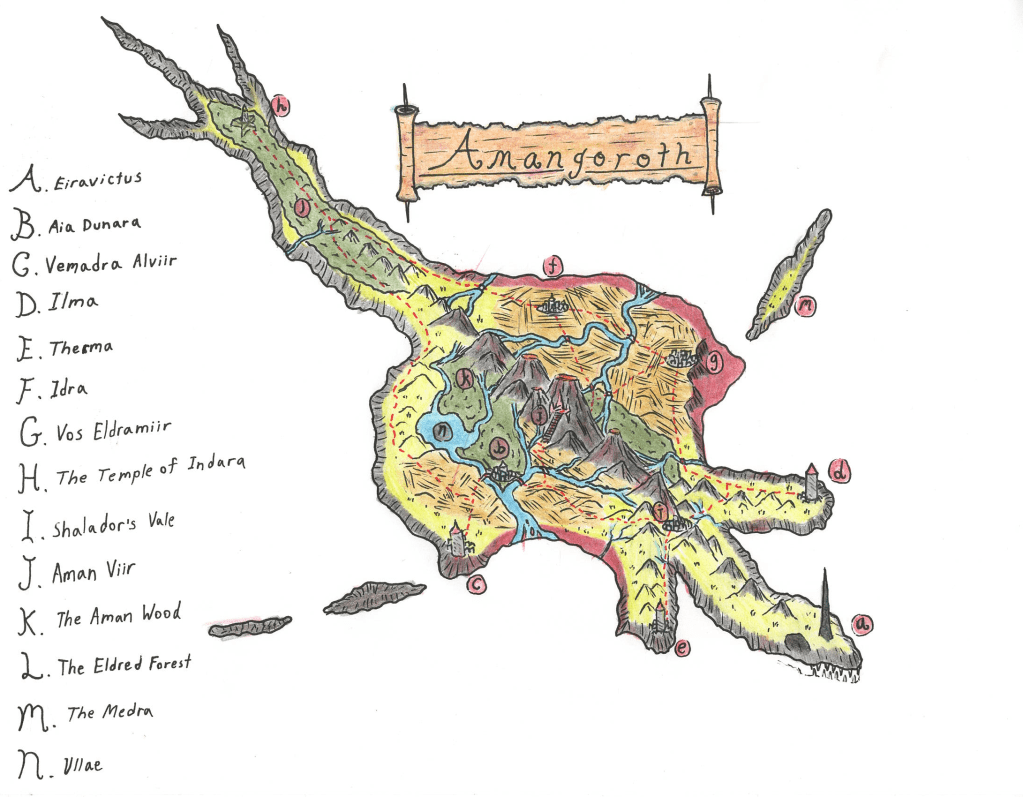
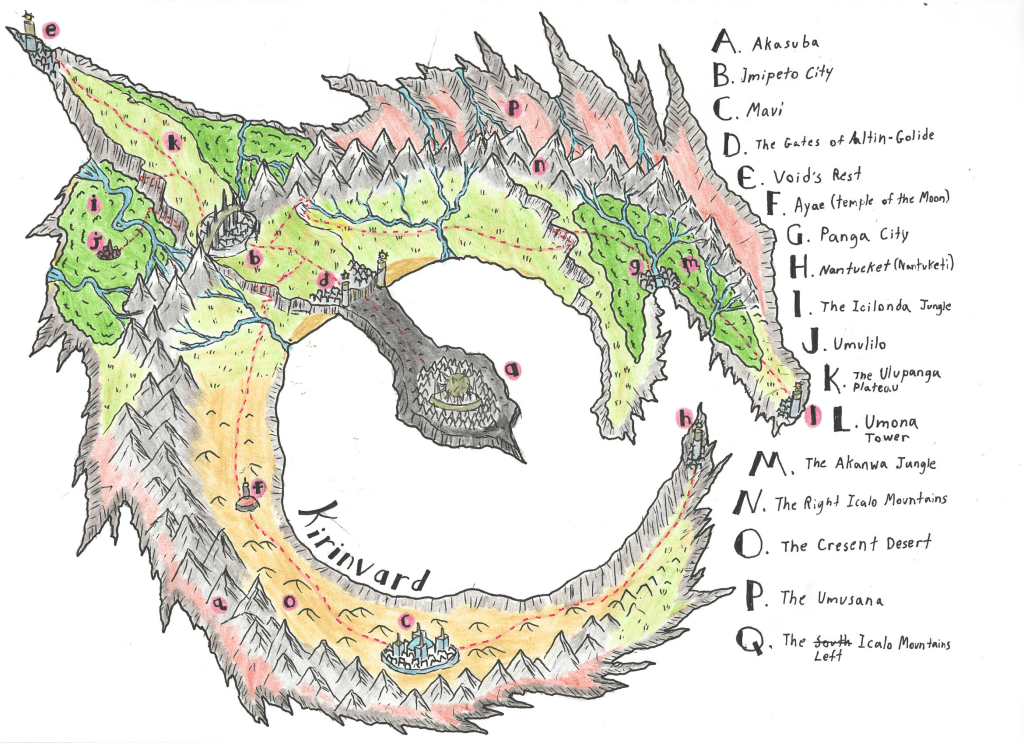
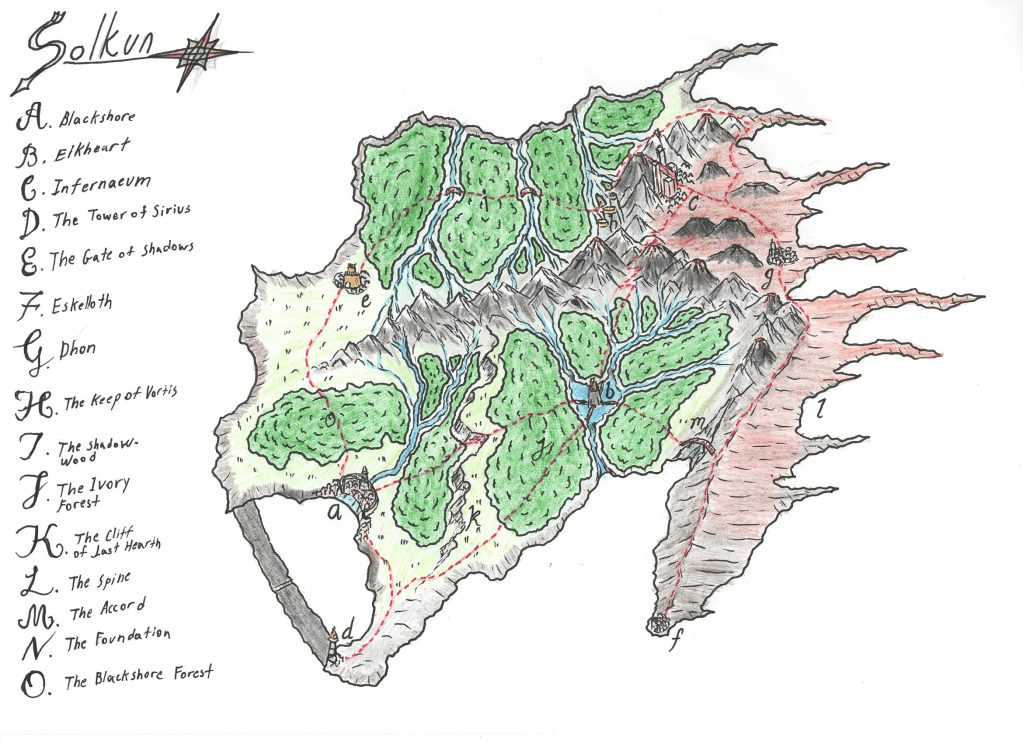
For the Hollow Sea, I moved away from using digital tools to draw my world maps. I tried to focus on creating my own style of map design. The result was something that appears less realistically proportioned, but has greater narrative depth, and I found that creating quests and missions was far more intuitive. I also focused on making sure that, regardless of the paths a party chose to follow, there would almost always be some interesting point of interest for them to discover along their journey.
Inspiration for the Hollow Sea
One of the primary sources of inspiration for the Hollow Sea campaign setting was the life cycles of certain parasites. Some parasites have evolved what is known as Adaptive Host Manipulation, which is where a parasite changes the physiology, morphology, or behavior of a host to better allow the parasite to reproduce and continue its life cycle. In the Hollow Sea, God’s Blood serves as a parasite that changes the physiology of its host, allowing them to cast more powerful spells. This host manipulation is on the surface beneficial for the hosts that survive the parasite, but this change acts as a Trojan horse for the behavioral changes the parasite induces. Those who have taken God’s Blood feel a need to travel toward the luminous anomaly known as the Rhine. This attraction has been explained by Scholars of the Hollow Sea as the divine choosing who they call home to the Rhine, but in truth, this attraction is a behavioral modification on the part of the parasite.
This brings us to my second primary source of inspiration, which is the Great Attractor. The Great Attractor is a gravitational anomaly that is slowly pulling all of the galaxies in the Laniakea Supercluster (our home supercluster) toward it. The Great Attractor is hidden from us by the galactic core of the Milky Way galaxy, so we cannot see it directly, but we can see its gravitational effects on our galactic neighbors. In the Hollow Sea, the Rhine cannot be seen directly as it is obscured by a luminous vale of stars and glowing gas, but its effects on the tides and courses of the floating islands are felt every day. The Rhine is actually a titanic creature feeding on the world. All those who sail into the Luminous vale are consumed by the Rhine. God’s Blood parasite, which has been brought into the Rhine by mages, uses the Rhine as its next host, continuing its life cycle. Even though God’s Blood is a parasite to the Rhine, it forms a symbiotic relationship with the Rhine by driving food (infected mages) into its very jaws.
Hiraeth
Hiraeth is a folk horror campaign setting. The world of Hiraeth is one where industry, economics, and magic have been used and exploited by a family of powerful entities called the Abandoned. For countless years, the Abandoned had been sealed away beneath the earth, but as industry grew, so did its thirst for mineral resources, and some things they were meant to remain locked away, buried in rock, were set loose. Miss Thorn was the first of her sisters freed, and she quickly set to work taking control of mortal industry, turning it to her own ends to free the remainder of her accursed sisters.
The opening of the campaign involves Miss Thorn orchestrating a logging disaster to create the necessary corpses for a ritual to awaken her sister Moro, an event the party gets caught up in during the first session.
Each sister represents a different aspect of death.
- Hema – Sickness and Disease
- Masla – Massacre and War
- Miss Thorn – Accident and Murder
- Moro – Self Destruction
- Saraith – Starvation and Exposure
- Scleros – Corruption and Decay
The Hiraeth campaign took place over the course of 8 months and included over 100 hours of playtime across 19 sessions.
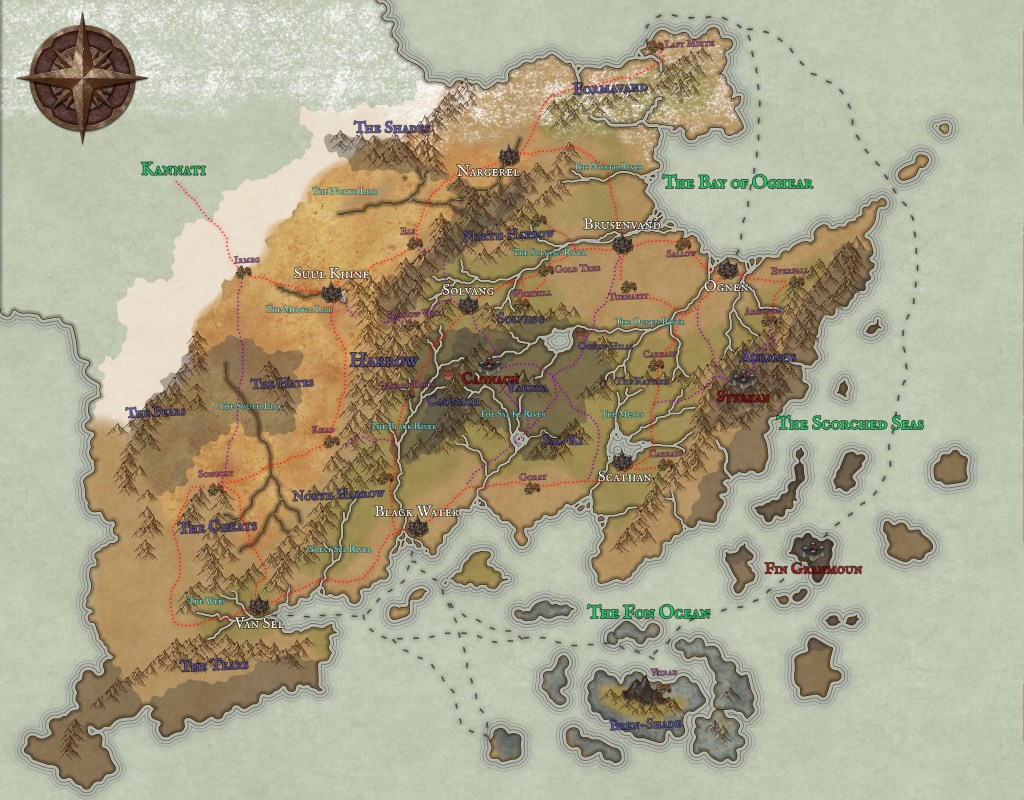
For the Hiraeth map, I really wanted to focus on crafting realistic geological features. Deserts formed where the mountains created a rain shadow, blocking evaporated water from the oceans from easily reaching them. I tried to focus on the river always flowing downward along the path of least resistance. Rivers that flow to the sea also create a realistic river delta and sediment buildup.
The original map was more zoomed in and cut off a region of the world, but as the campaign progressed, I realized the party was keen on exploring those regions, so I created a new version of the map that showed all of the explorable land on Hiraeth.
Inspiration for Hiraeth
The Hiraeth campaign setting as a concept was inspired primarily by the Welsh concept of hiraeth, which means a longing or desire for a home that cannot be returned to or perhaps never existed in the first place. This longing for a place that no longer is or perhaps never was ties together the majority of the characters in this story. The Abandoned are the children of Entropy and seek a home with their creator, one where the death of reality is absolute, and they might be at peace. But as their name suggests, they have been abandoned by Entropy, and now exist, striving to remake the world into a home that will never be. Many of the heroes of this story likewise found themselves without a place to call home or a family to call their own. The world of Hiraeth explores how the corruption of industry and power causes the displacement of people’s sense of home. Either because they physically lose the place they once knew or because they are made to yearn for riches and a way of life that will never be delivered.
Hiraeth in this setting is personified by a character who is the displaced soul of the world, locked away by dark forces. She yearns above all else to find a home in the stars, a home that has never been, but just maybe it is a home that will be.
For the cultures, cities, and villages, I was greatly inspired by early 20th-century Appalachia and specifically the horror anthology podcast, Old Gods of Appalachia
Vaedra
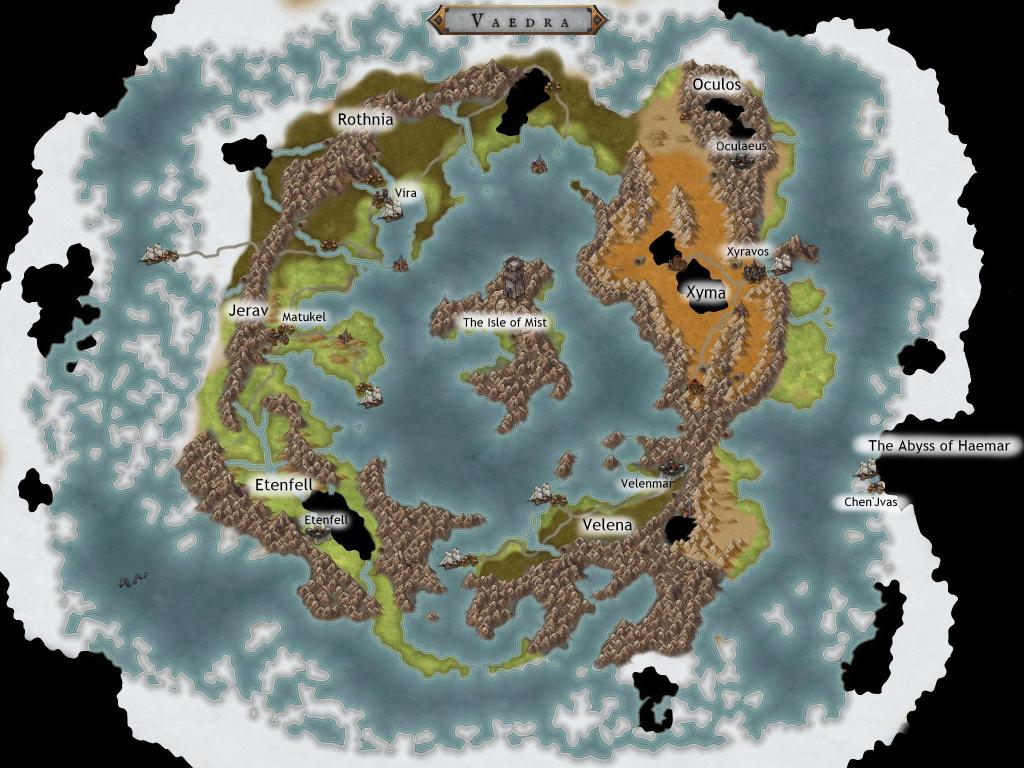
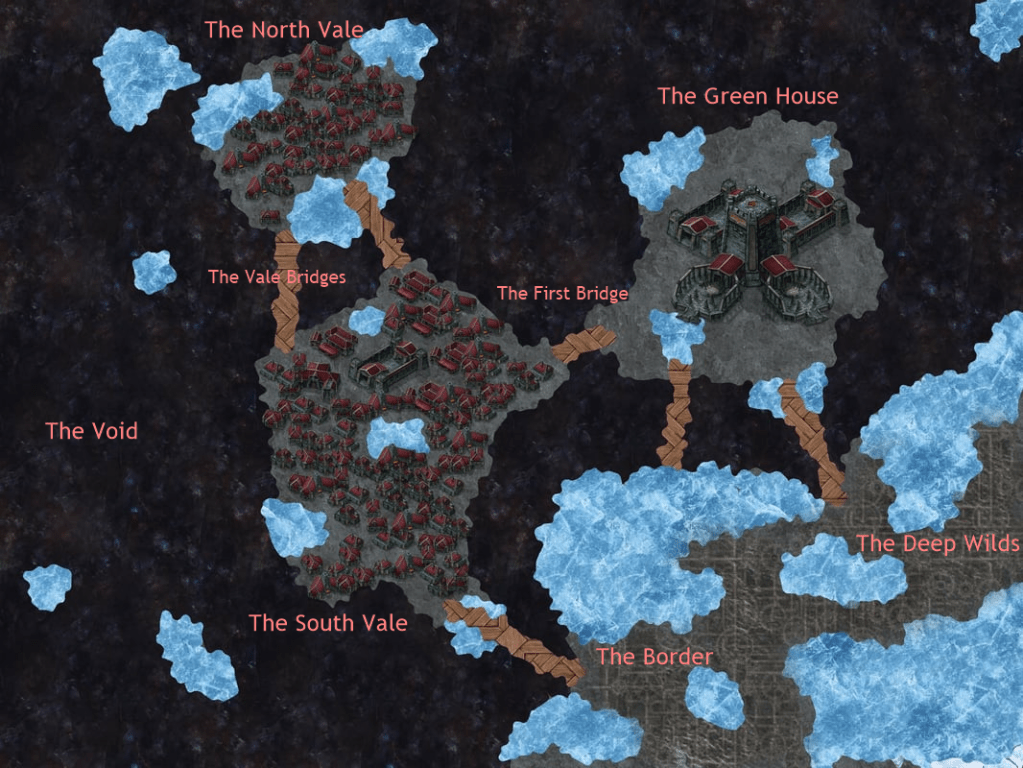
Vaedra is a campaign setting where the world is being eaten away by an ever-encroaching void. Fragments of the world have become isolated from each other as they drift apart deeper into darkness. As the world fragments drift apart, new chunks are breaking off, slowly shrinking the world and growing the void. Vaedra is a setting defined by the ways in which people cope with the slow decay and eventual death of their homelands. A lich tries to use a cursed fungi to steal the memories and souls of an entire land’s population so that he can build a mycotic hive mind where everyone can live a simulated existence even as the world around them breaks apart. A civilization of gnomes uses a device that tortures their kin and extracts their souls to generate power to hold their dying city together for just a little longer. A fallen dwarven city entrusts a single dwarf with the memories of an entire people, simply so they are not forgotten as the world ends.
The Vaedra campaign took place over the course of eight months and included over 150 hours of playtime across 20 sessions.
Inspiration for Vaedra
Vaedra drew a great deal of inspiration from the Hindu religion and its ideas of a cyclical existence where one must let go of their own desires in order to achieve Moksha, true enlightenment, and union with a collective whole. I was specifically inspired by Shaktism, a Hindu denomination that believes that Shakti is the primordial power that drives the universe and everything in it. Vaedra is an exploration of a cyclical universe in which souls live multiple lives until reaching maturity, at which point they can become one with the whole. As the universe ends, it is recombing of a primordial energy that allows for the creation of a new world, thus the cycle repeats.
Documents & Designs
Trails on Ti-Pujara
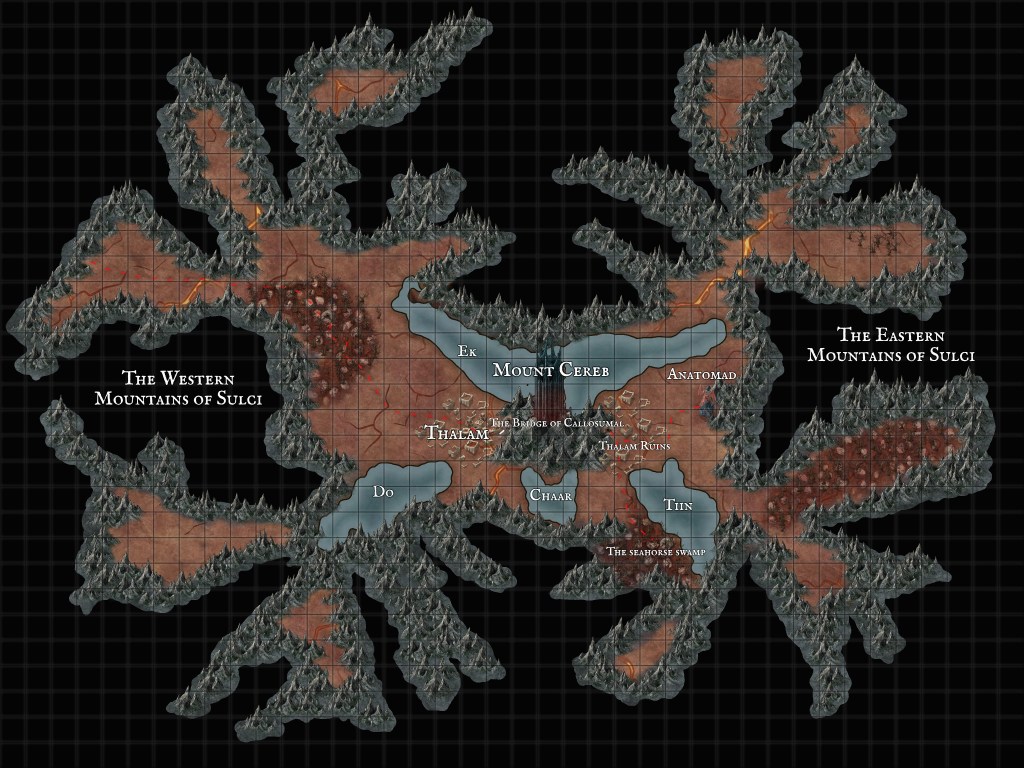
The Trails on Ti-Pujara is a campaign arc in the Vaedra campaign setting. It is a story focused on the dynamics of memory and its connection to the soul. Most of the characters are suffering from severe memory loss brought on by the schemes of an infernal entity. Though the source of their plight is super natural, I wanted to focus on what life would be like for a culture that could not remember anything before from a time before they woke up that day. How would the able-bodied care for the sick? How would people navigate their surroundings and their relationships when ever day you awoke in a strange place filled with strangers?
To immerse myself and my player in the feels of memory loss, this arc was played in reverse chronological order from end to beginning. At the end of each day, we would jump into the past to play through the previous day. This simulated the effect of not remembering what came before because we hadn’t played it yet. This style of play required a great deal of trust between GM and player, and we were able to navigate this complex dynamic with remarkable consistency.
This arc was heavily inspired by the album Everywhere at the End of Time by The Caretakers. An album that explores the memory loss caused by dementia and other similar neurodegenerative diseases. In keeping with the themes of mental atrophy, many of the character names and locations are based on parts of the brain and neurodegenerative ailments or symptoms.
The Edge of the World
The Edge of the World is a mini arc set in the village of Chen’Jvas. The spirit of an unnamed child haunts the denizens of this village on the edge of the world. The party must uncover the mystery behind this child’s death in order to lay her spirit to rest and save Chen’Jvas from the monstrous aspects of a restless spirit.
This was a story I wrote to pair with the backstory of one of my players for a campaign. I ran this version, with the character details removed, as a lengthy one-shot.
The Treasure of Captain Albatross
The Treasure of Captain Albatross is set in a world dominated by oceans. Land is rare, and dying on land is equally rare. Thus, the Peyi, the death on the land, has grown very jealous of her sister, the death in the sea, since her sister reaps more souls and thus is far more powerful. Peyi’s anger reaches a tipping point when her sister takes a mortal lover. Peyi resolved to kill her sister’s lover, Captain Albatross, by tricking Captain Albatross’s former crew into helping her find and destroy the sea captain’s soul.
This was a one-shot idea I had while driving to a Dungeons and Dragons one-shot night. I was inspired by Haitian culture for the setting and the names of the two deaths. Peyi Lanmo means “Land Death,” and Lanme Lanmo means “Sea Death” in Haitian Creole.
The Dreaming Dead
The Dreaming Dead takes place in the land of the dead and features a series of foes and obstacles that must be overcome to allow for the souls of the party to return to the land of the living.
It is a fairly straightforward one-shot with the added complexity that the trials the party must overcome can be done in any order. This adds a sense of depth to the story.
I have run this one-shot multiple times for players with a wide variety of experience with TTRPGs. The order-agnostic nature of the quest structure gives this one-shot a great deal of replayability, and it has become my go-to one-shot in a pinch.
Below is a quest chart for The Dreaming Dead one-shot.
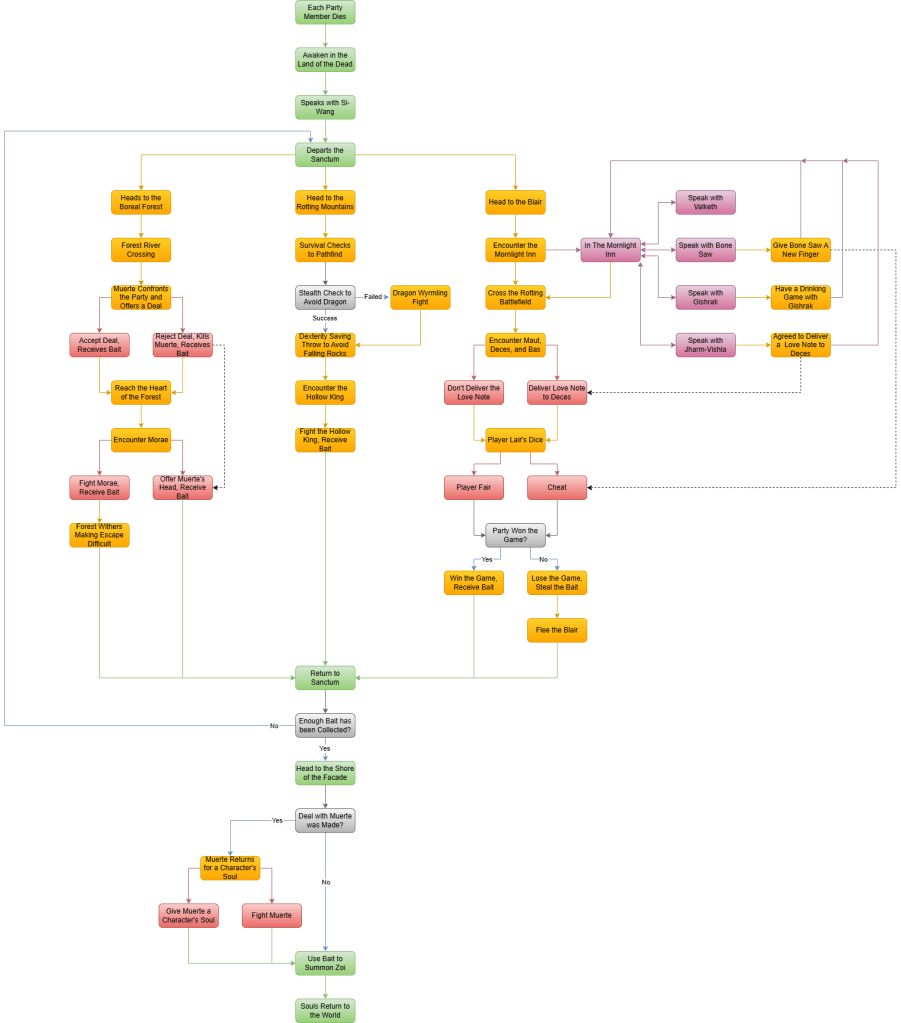
- Green Nodes: indicate a region of linear quest progression.
- Yellow Nodes: indicate a quest objective that can be abandoned and resumed.
- Peach Nodes: indicate branching player choices that cannot be easily undone.
- Grey Nodes: indicate a status check. If the condition is met, the quest progresses down the path. If it is not, the quest progresses down the alternate path.
- Pink Nodes: indicate a quest step that can easily be repeated multiple times.
- Black Arrows: indicate choices that are prerequisites for previous choices.
Monster Design
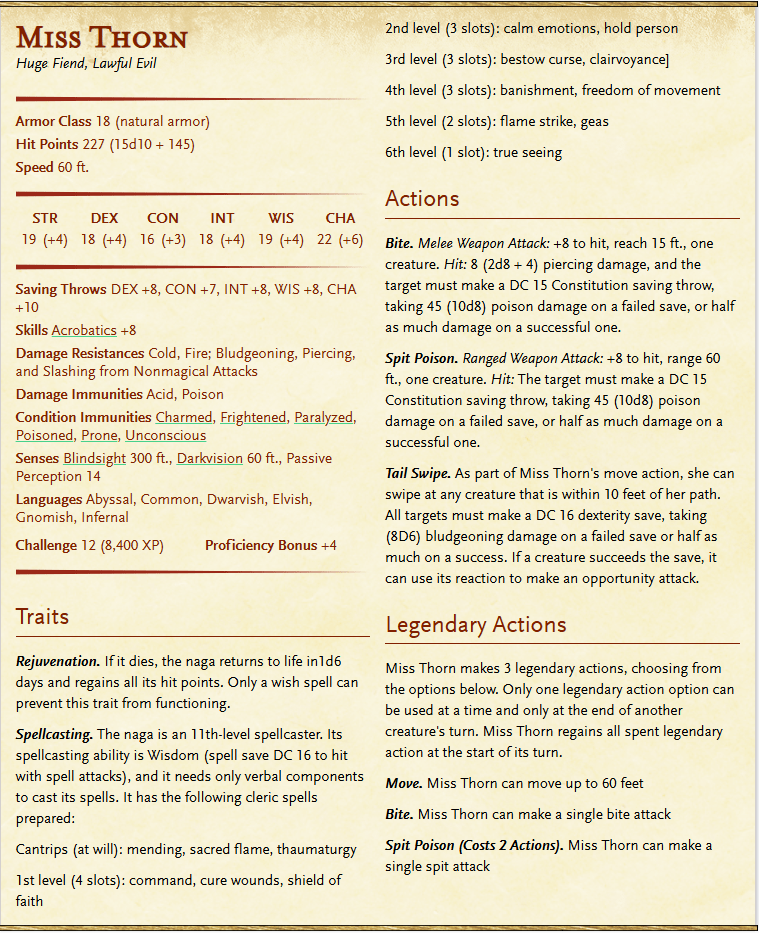
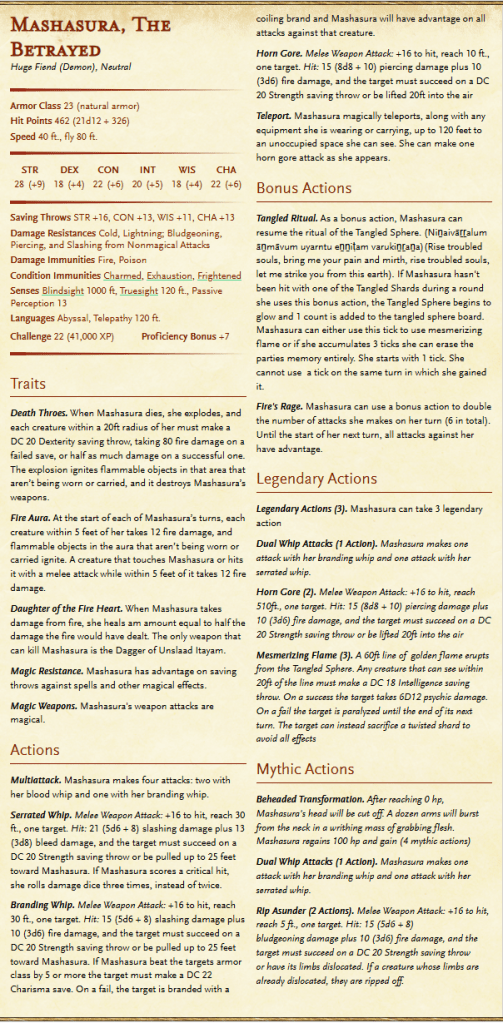
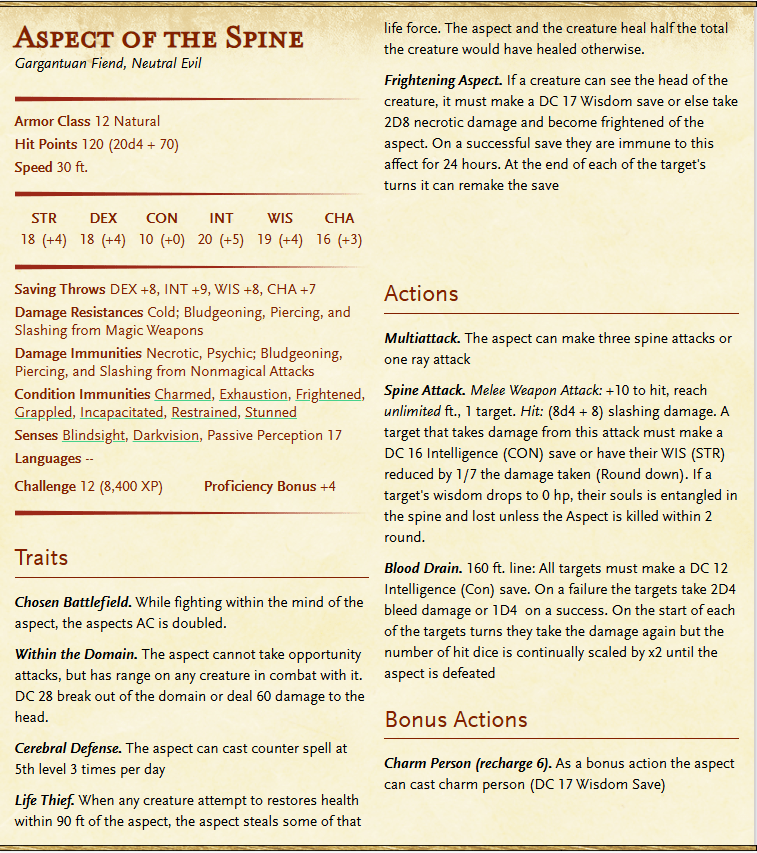
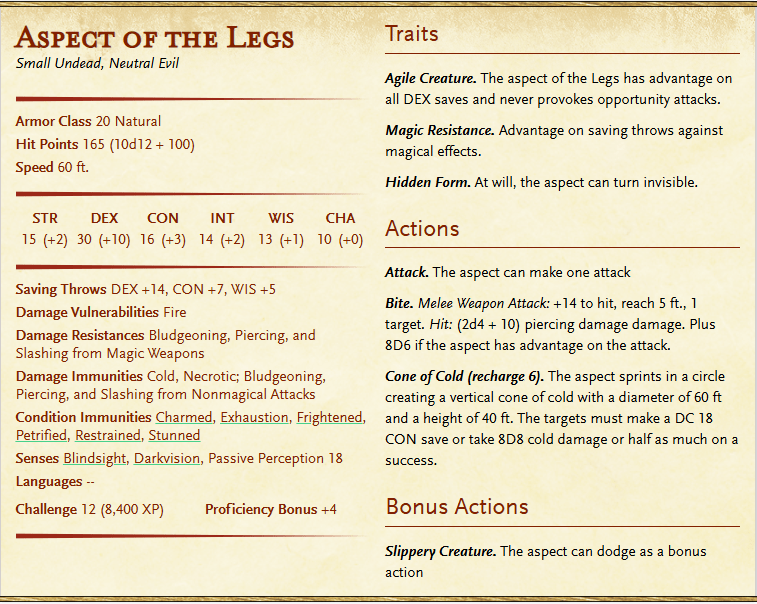
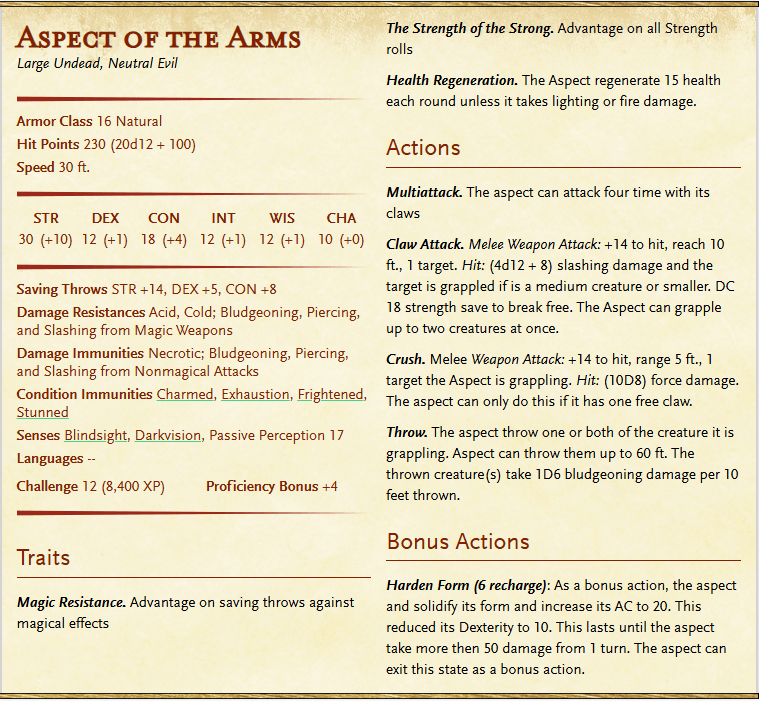
5e Monster Designs
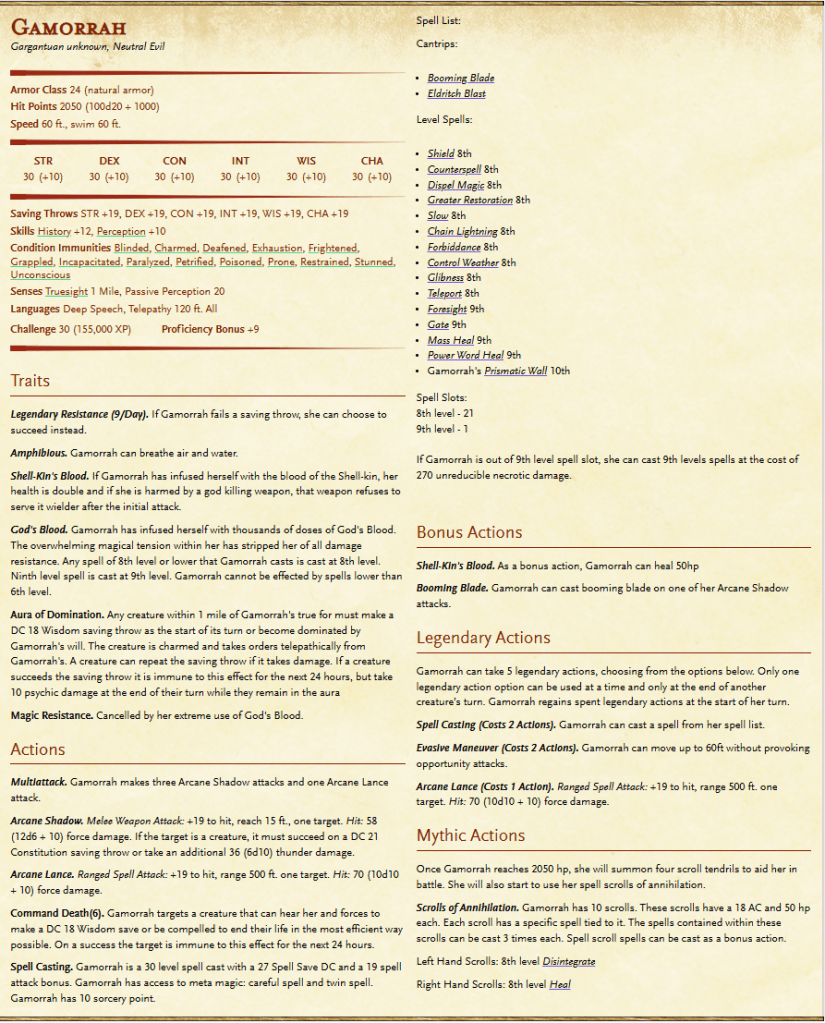
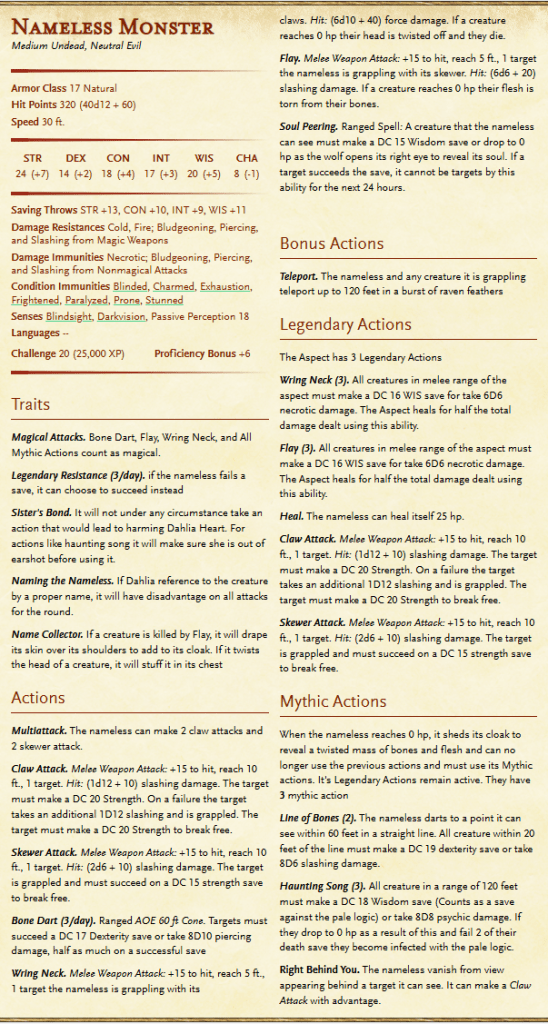
A collections of some homebrew monsters I have created. I usually approach monster design from a story first perspective and typically make my own monster for narratively significant fights and encounters. I typically run game for parties of 6 or more, so combat balancing can get somewhat challenging.
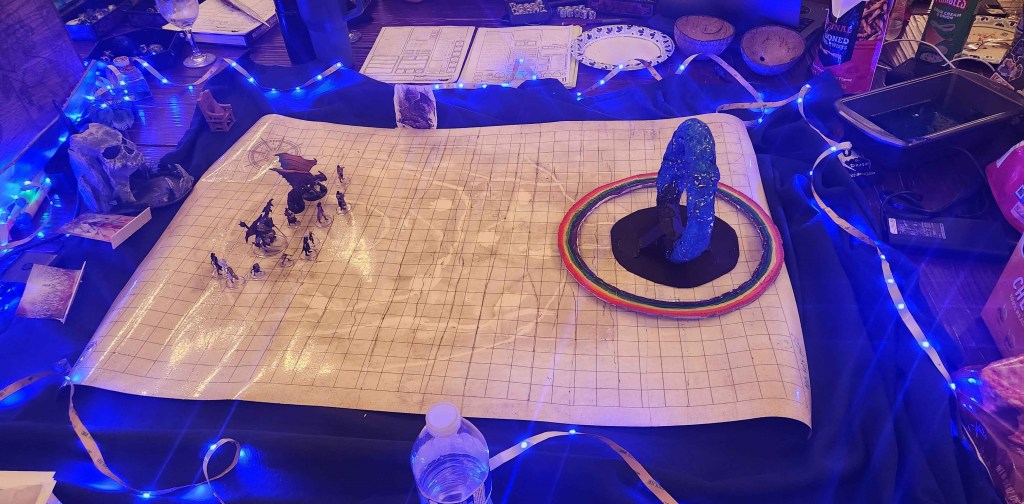
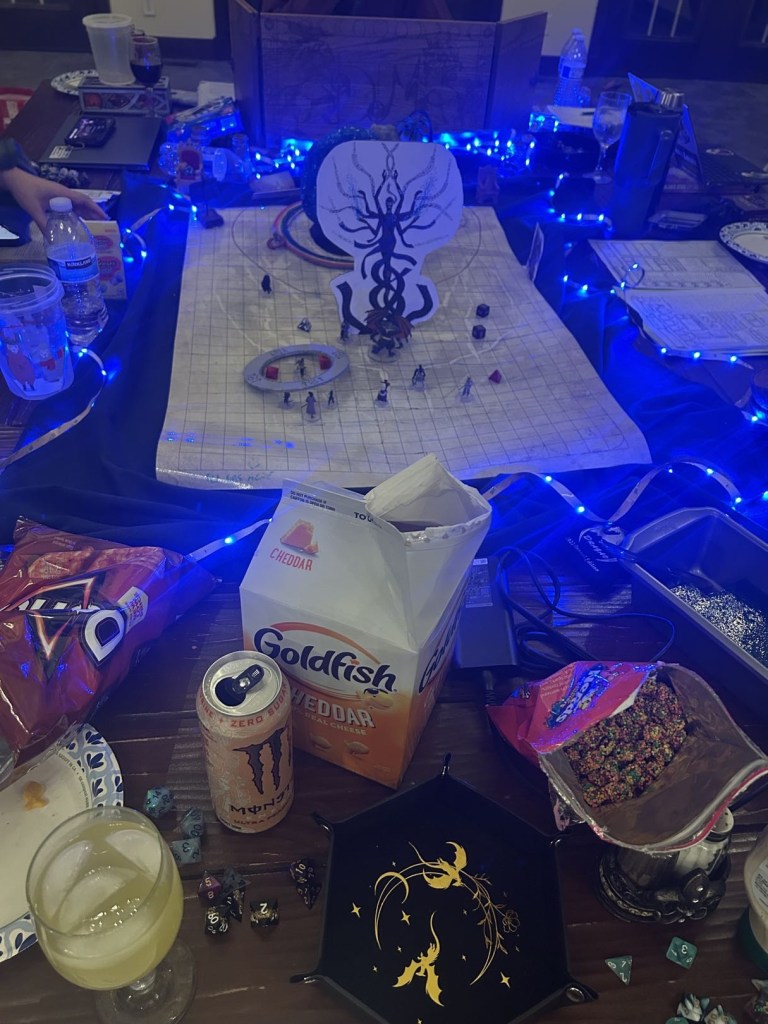
I recently ran an encounter that had 12 player characters at level 20 as a campaign capstone. For the encounter I wanted to focus on something other than dealing damage to the boss, so I setup a puzzle with a modified version of the dungeons and dragon’s spell prismatic wall. Completing the puzzle would end the combat, which drew player focus away from just dealing damage to the boss and her minions.
Images and Art
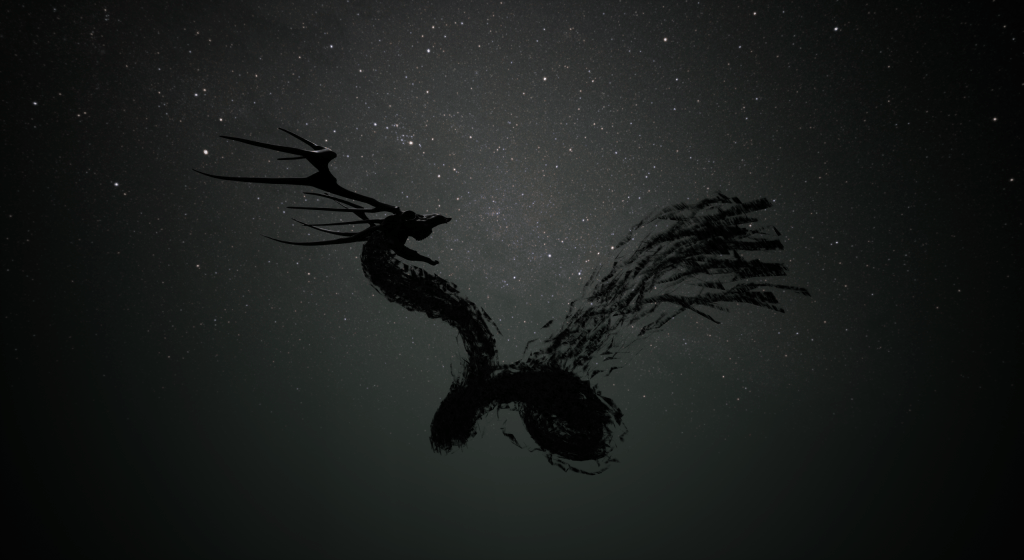
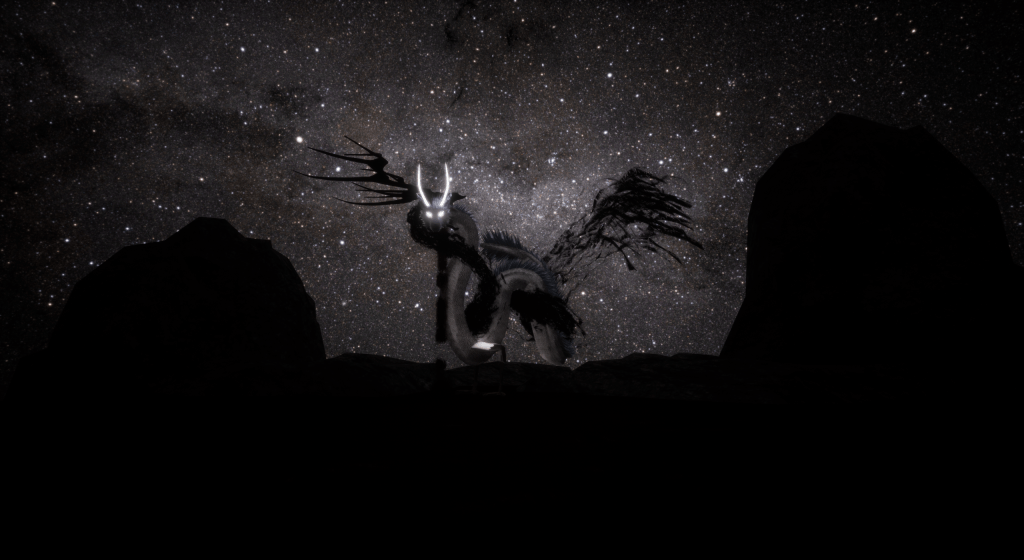
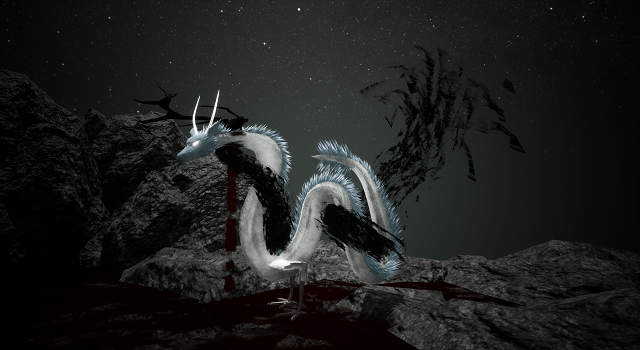


 Yiorgos Bereveskos